A practical way to enjoy brunches, business dinners and meals with friends—without turning food into a test of discipline.
Living in Doha often means that food is part of the social calendar.
There are Friday brunches, business lunches, hotel buffets, celebrations, coffee meetings and spontaneous dinners with friends. Trying to avoid all of them in the name of progress is neither realistic nor necessary.
A healthy lifestyle should give you more capacity to enjoy your life—not require you to withdraw from it.
The challenge is not that one restaurant meal will undo your training. It will not. The difficulty appears when frequent meals out become consistently larger, richer and less balanced than the meals your body normally needs.
Research suggests that food prepared away from home often contributes more energy, fat and sodium while sometimes providing fewer micronutrients than food prepared at home. However, the relationship between eating out and body weight is complex, and the evidence does not mean that restaurants must be avoided.
The useful question is not:
How can I eat perfectly at a restaurant?
It is:
How can I make choices that support my goals while still enjoying the experience?
Do not arrive extremely hungry
Saving all your food for dinner may sound sensible when you expect a large meal.
In practice, arriving excessively hungry can make it much harder to notice fullness, choose calmly or enjoy food without urgency. It may also create a cycle of restriction followed by eating beyond comfort.
You do not need to “earn” dinner by skipping breakfast or lunch.
Eat your usual meals and include foods that provide protein, fibre and satisfaction. If dinner will be late, a small snack beforehand may help:
- fruit with a handful of nuts;
- soy yoghurt;
- hummus with vegetables;
- a protein shake;
- edamame;
- wholegrain toast with nut butter.
The goal is not to remove your appetite. It is to arrive hungry enough to enjoy the meal, but not so hungry that every decision feels like an emergency.
Choose what matters most to you
Restaurant meals often present several opportunities at once:
- bread and dips;
- starters;
- main courses;
- side dishes;
- desserts;
- sweet drinks or alcohol.
There is no rule saying you cannot have more than one. But choosing everything automatically can leave you eating long after the experience has stopped being enjoyable.
Before ordering, decide what you genuinely want.
If the dessert is special, enjoy it and choose a simpler starter. If the bread and mezze are your favourite part of the meal, allow space for them instead of eating them while waiting for a large main course.
Intentional choice feels very different from restriction.
You are not asking, “What am I allowed to eat?”
You are asking, “What will make this meal satisfying?”
Build an anchor around protein and plants
You do not need to calculate every calorie or recreate a fitness meal in the middle of a restaurant.
A simple structure is usually enough:
- Choose a meaningful protein source.
- Include vegetables, salad, fruit or another fibre-rich food.
- Add the carbohydrate and fats that suit the meal and your appetite.
For someone eating a plant-based diet in Doha, protein options may include:
- lentil or bean dishes;
- chickpeas and hummus;
- tofu or tempeh;
- edamame;
- bean-based salads;
- grilled vegetable dishes containing legumes;
- dal and other pulse-based curries.
Some plant-based restaurant dishes appear light but contain very little protein. A salad made mainly from leaves may not keep you satisfied for long. Consider adding beans, tofu, lentils or another substantial component.
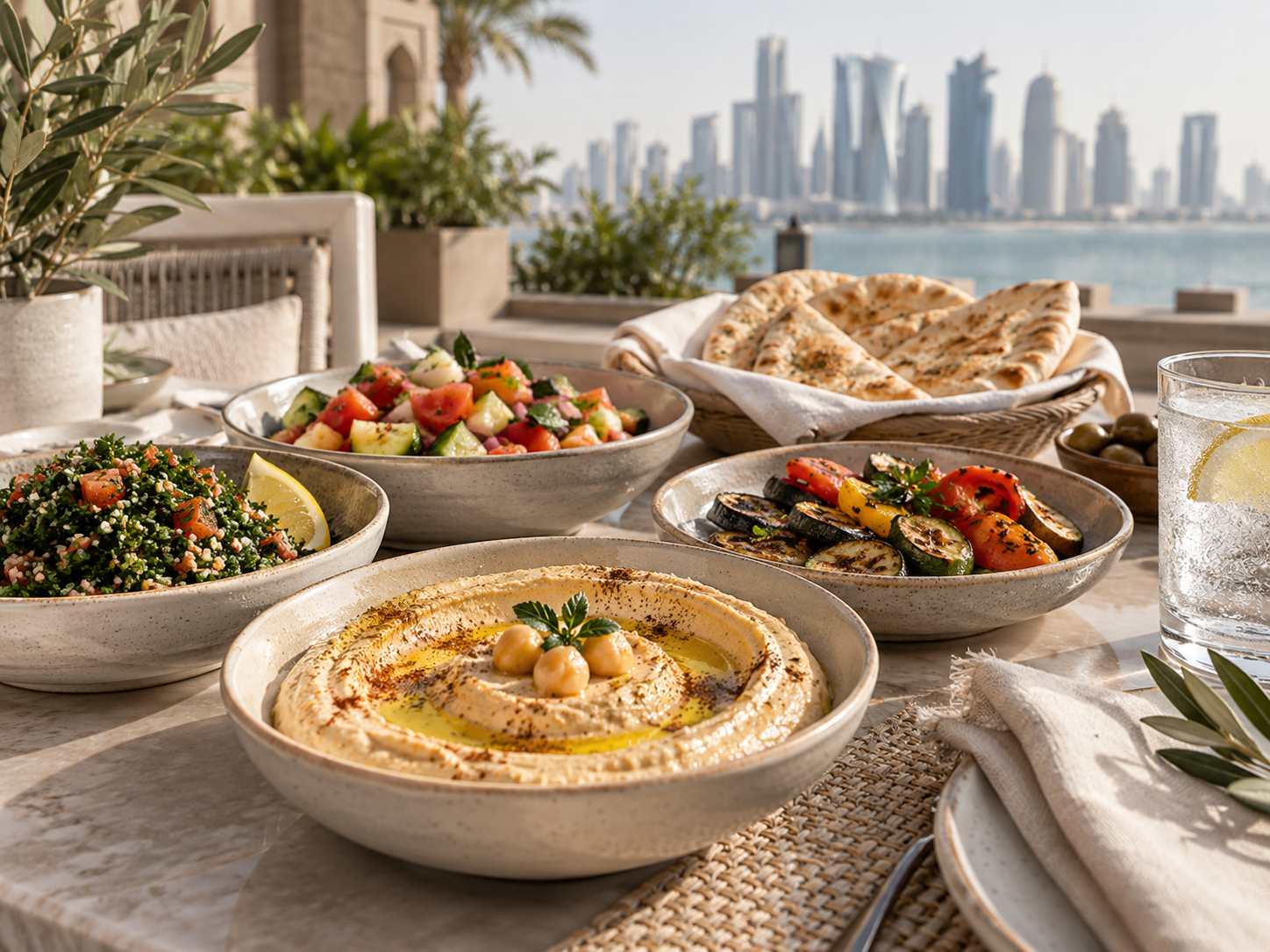
At Lebanese and Middle Eastern restaurants, mezze can provide excellent options, but it is easy to underestimate the total meal when many small plates arrive together. Hummus, moutabal, falafel, bread, stuffed vine leaves and fried appetisers may each feel small while collectively forming a very generous meal.
You do not need to avoid them. Simply allow them to count as part of dinner.
Portions are information, not instructions
A restaurant portion is what the restaurant decided to serve. It is not a prescription for what your body needs.
Studies consistently find that larger served portions tend to increase food and energy intake. Research also suggests that reducing portion size can meaningfully reduce daily energy intake, although individual responses vary.
This does not mean you need to measure your food at the table.
Try a few practical strategies:
- pause halfway through the meal;
- check whether you are still hungry or simply continuing;
- share a starter or dessert;
- order one dish first and add more if needed;
- leave food when you are comfortably satisfied;
- take leftovers home when appropriate.
Finishing everything is not automatically waste prevention. If the portion is much larger than you need, eating beyond comfort does not recover the value of the food.
Approach buffets with a plan
Brunches and buffets are deliberately designed around abundance and variety. The desire to try everything is normal.
A rigid restriction strategy can backfire, especially when you feel this is your only opportunity to eat certain foods.
Instead, begin by looking at the complete selection before filling your plate.
Choose the foods you actually want—not everything that happens to be available.
A practical approach might be:
- begin with a plate containing vegetables, salads and a protein source;
- add the dishes that feel most special;
- sit down and eat rather than continually grazing;
- wait a few minutes before returning;
- choose dessert intentionally instead of sampling it simply because it is there.
You are allowed to enjoy a generous meal. The aim is to remain present enough to recognise when enjoyment becomes discomfort.
Drinks can change the meal quickly
Sweetened drinks, speciality coffees and alcohol may add considerable energy without creating the same fullness as food.
You do not have to drink only water forever. But it helps to decide rather than refill automatically.
You might alternate an alcoholic drink with water, choose one drink you genuinely enjoy or stay with sparkling water and lime when the beverage is not important to the occasion.
In Doha’s heat, hydration also deserves attention. Thirst, long periods in air conditioning and outdoor activity can affect how you feel during a meal and during training the following day.
Do not punish the meal afterwards
One of the least helpful responses to eating more than planned is trying to compensate with extreme restriction or excessive exercise.
This turns one enjoyable event into several difficult days and reinforces an all-or-nothing relationship with food.
Your body weight may temporarily increase after a restaurant meal because of food volume, carbohydrates, sodium and fluid retention. This is not the same as suddenly gaining an equivalent amount of body fat.
Return to your normal routine:
- drink water;
- eat your usual meals;
- include vegetables, protein and fibre;
- move normally;
- complete your scheduled training;
- sleep.
Consistency is restored through ordinary actions—not punishment.
Progress is shaped by patterns
If you eat out occasionally, the individual meal deserves very little anxiety.
If you eat out several times each week, restaurant choices become part of your normal pattern. That does not make progress impossible, but it may require more consistent decisions.
You could:
- identify restaurants where balanced meals are easy to order;
- request sauces or dressings separately;
- choose grilled, baked or steamed options more often;
- share very large dishes;
- balance richer social meals with straightforward everyday meals;
- decide which occasions matter most rather than treating every dinner as a special event.
The goal is not perfection. It is creating a pattern you can maintain.
Caroline’s practical starting point
Before your next meal out, choose three anchors:
- I will not arrive excessively hungry.
- I will include a useful protein source.
- I will choose the part of the meal I most want to enjoy.
Everything else can remain flexible.
You do not lose progress by participating in your life. Progress is protected when your routine is strong enough to include restaurants, celebrations and pleasure without turning them into emergencies.
Would you like a realistic training and lifestyle plan that works in Doha—not only in a perfect week? Book a consultation.