They are often presented as competing choices. In reality, the answer depends on what you want your body to be able to do.
“Should I do Pilates or strength training?”
It sounds like a simple question, but it usually contains several others:
- Which one is better for my back?
- Which one will change my body?
- Which one will make me stronger?
- Which is safer?
- Do I need to choose only one?
Pilates and strength training overlap in several ways. Both can build muscular endurance, improve movement control and make everyday activities feel easier. Both can also be adapted for beginners, older adults and people returning to exercise.
But they are not identical—and neither method is automatically superior in every situation.
The useful question is not which one wins.
It is which qualities you need to develop and whether your current programme provides them.
What Pilates does particularly well
Pilates teaches you to pay attention.
Movements are usually performed with control, deliberate breathing and awareness of the relationship between your spine, pelvis, ribcage and limbs.
Depending on the style and equipment used, Pilates can develop:
- trunk control and endurance;
- coordination;
- balance;
- mobility;
- body awareness;
- controlled strength through different ranges of movement;
- confidence after a period of inactivity or pain.
Research suggests that Pilates can improve balance in older adults and may support several measures of physical function. Evidence also indicates that it may help some people with chronic nonspecific lower-back pain, although it is not the only effective form of exercise for that condition.
Pilates can be especially useful for someone who feels disconnected from movement or finds traditional gym training intimidating.
It creates a setting in which quality, breathing and control receive as much attention as completing the exercise.
What strength training does particularly well
Strength training is a broad category.
It includes free weights, machines, resistance bands, bodyweight exercises and many other ways of asking muscles to work against resistance.
Its defining feature is not a particular piece of equipment. It is progressive overload: gradually increasing the challenge as your body adapts.
Strength training can be specifically developed to improve:
- maximum strength;
- muscle mass;
- bone-loading capacity;
- power;
- the ability to lift, carry, push and pull;
- tolerance for demanding daily or sporting tasks;
- long-term physical independence.
A well-designed strength programme makes progression measurable. You may gradually lift more weight, perform more repetitions, use a greater range of motion or complete a more challenging variation.
Research comparing different resistance-training prescriptions consistently shows that many approaches can build strength and muscle, provided the exercise is sufficiently challenging and progressed over time.
This scalability is one reason strength training is difficult to replace when the main goal is to become substantially stronger or preserve muscle and bone as you age.
Can Pilates make you strong?
Yes.
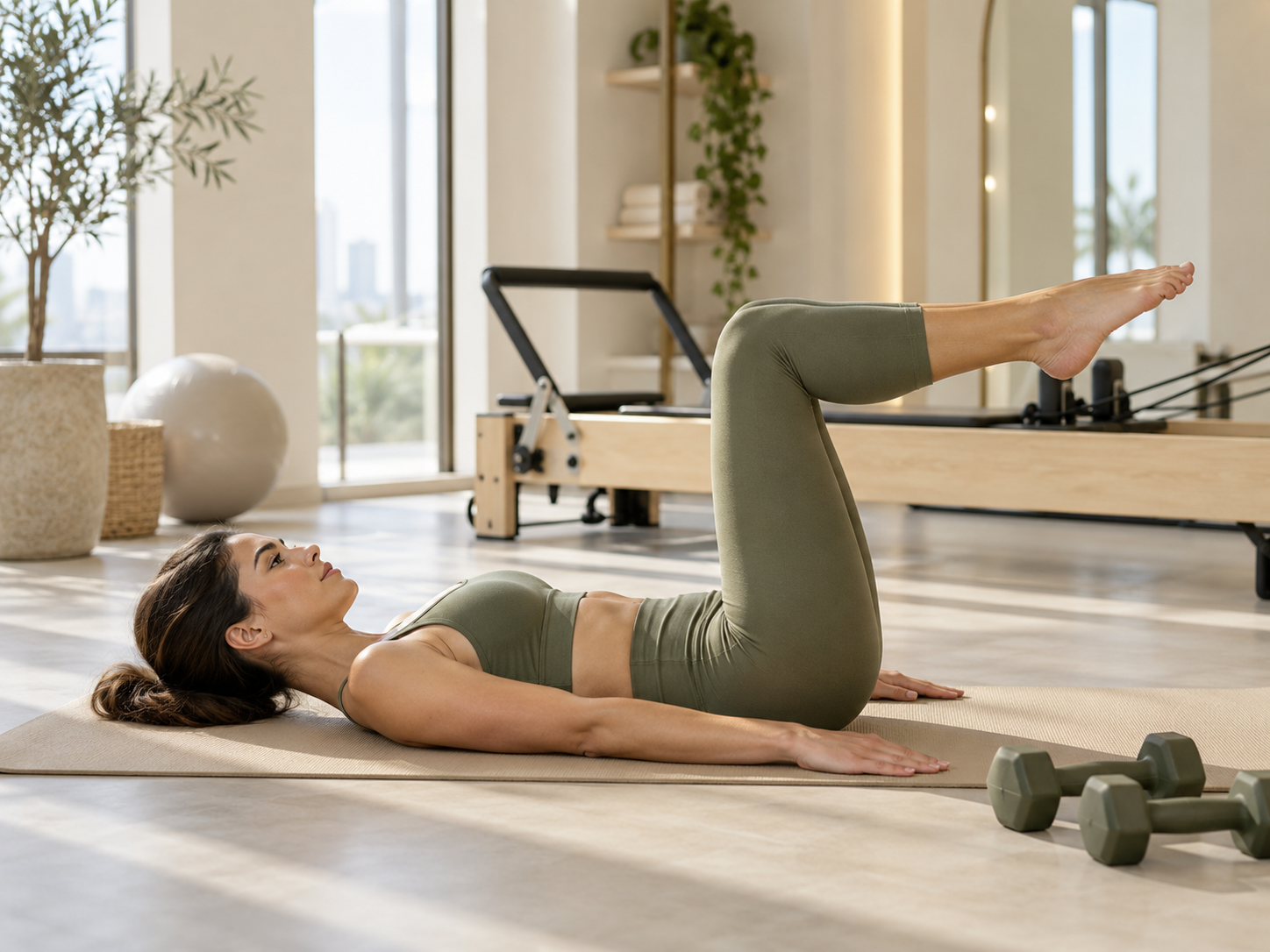
Pilates exercises can be very demanding. Anyone who has controlled a slow reformer movement or maintained a challenging mat position knows that Pilates is not simply stretching.
It can improve strength, particularly in people who are new to exercise or in movements they have not previously trained.
However, strength is specific.
Becoming better at controlled trunk work does not automatically prepare you to lift a heavy suitcase from the floor, carry large shopping bags or progressively build lower-body strength.
A systematic review comparing Pilates with other exercise methods found no clear evidence that Pilates is universally better for increasing muscular strength. The answer depends on the population, programme and strength measure being assessed.
As you become more experienced, developing higher levels of strength usually requires resistance that can continue to increase.
Pilates can contribute to that process, but it may not provide the complete stimulus by itself.
Is strength training good for movement quality?
It can be.
Poorly coached strength training is not the definition of strength training, just as rushed Pilates is not the definition of Pilates.
A thoughtful strength programme also requires:
- controlled technique;
- appropriate breathing;
- joint awareness;
- stable positioning;
- gradual progression;
- the ability to produce and absorb force.
Strength training does not have to make you stiff. Moving resistance through an appropriate range can develop both strength and usable mobility.
The quality of the programme and coaching matters more than the label attached to the exercise.
Which one is better for back pain?
There is no exercise method that is universally best for every back.
Pilates has evidence supporting its use for some people with chronic nonspecific lower-back pain. It may reduce pain and disability compared with minimal or no exercise. But comparisons with other well-designed exercise programmes are less clear, and individual response remains important.
Strength training can also be appropriate for people with back pain when exercises are selected, coached and progressed properly.
The decision should consider:
- the nature and duration of symptoms;
- medical assessment when necessary;
- previous exercise experience;
- movements that are currently tolerated;
- fear or confidence around loading;
- the person’s goals;
- access to qualified instruction.
Pain does not automatically mean your body is fragile. But persistent, severe or unusual symptoms should be properly assessed rather than self-diagnosed through social media.
Which one changes body composition?
Both forms of exercise use energy and can contribute to an active lifestyle.
However, when the goal is to build or preserve muscle mass, progressive strength training offers a more direct and measurable route.
Body-fat changes depend on a wider pattern that includes nutrition, total activity, recovery, sleep and consistency. Neither Pilates nor lifting weights can guarantee a specific aesthetic result.
The most effective programme is not the one advertised as creating the longest or leanest muscles. Muscles do not become “long” because of a particular exercise brand.
A good programme develops your body’s capabilities while respecting your preferences and goals.
Do you need to choose?
Often, no.
Pilates and strength training can complement each other extremely well.
For example, a balanced week might include:
- two full-body strength sessions;
- one Pilates session;
- walking, cycling or another form of cardiovascular activity;
- adequate recovery.
Another person may use Pilates as the main entry point into exercise and gradually introduce resistance training.
Someone already lifting regularly might use Pilates to explore control, breathing, balance and movement variety.
The correct balance depends on the individual—not on the popularity of either method.
If you only have time for two sessions
Your decision should reflect your main priority.
Choose a strength-focused programme if your primary goals include:
- building or preserving muscle;
- improving bone-loading capacity;
- becoming measurably stronger;
- preparing for physically demanding work or sport;
- maintaining independence with age.
Choose Pilates as your initial focus if your priorities include:
- rebuilding confidence in movement;
- improving body awareness and coordination;
- practising controlled trunk work;
- developing balance;
- returning to activity through a method you enjoy and will attend consistently.
But these are not permanent boxes.
A good Pilates programme can contain meaningful resistance. A good strength programme can include balance, mobility and precise movement.
The boundaries are less rigid than fitness marketing suggests.
The best choice is the one with a progression plan
Whichever method you choose, ask:
- Is the programme becoming appropriately more challenging?
- Does it address my actual goals?
- Am I learning useful movement skills?
- Can I recover from it?
- Can I maintain it?
- Is there a reason behind the exercises?
Repeating the same comfortable session indefinitely may feel pleasant, but it may stop creating meaningful adaptation.
Progress does not always mean adding more weight. It can involve better control, increased range, more repetitions or greater confidence.
There should still be a direction.
Caroline’s practical approach
You do not need to join a team called Pilates or a team called strength training.
Your body benefits from multiple qualities:
- strength;
- mobility;
- balance;
- coordination;
- cardiovascular capacity;
- confidence.
Choose the combination that develops what you currently lack while keeping enough enjoyment that you can remain consistent.
Pilates can teach you to organise movement.
Strength training can expand what that organised body is capable of doing.
For many people, the most complete answer is not either/or.
It is both—with a clear purpose.
Not sure which approach matches your body and goals? Book a consultation and build a programme around what you actually need.
References and further reading
- Is Pilates better than other exercise for increasing muscular strength? A systematic review.
- Effectiveness of Pilates for lower-back pain: systematic review and meta-analysis.
- Pilates and balance in older adults: systematic review and meta-analysis.
- Resistance-training prescription for strength and hypertrophy: systematic review and network meta-analysis.